
What to Expect From Your First Virtual Therapy Session
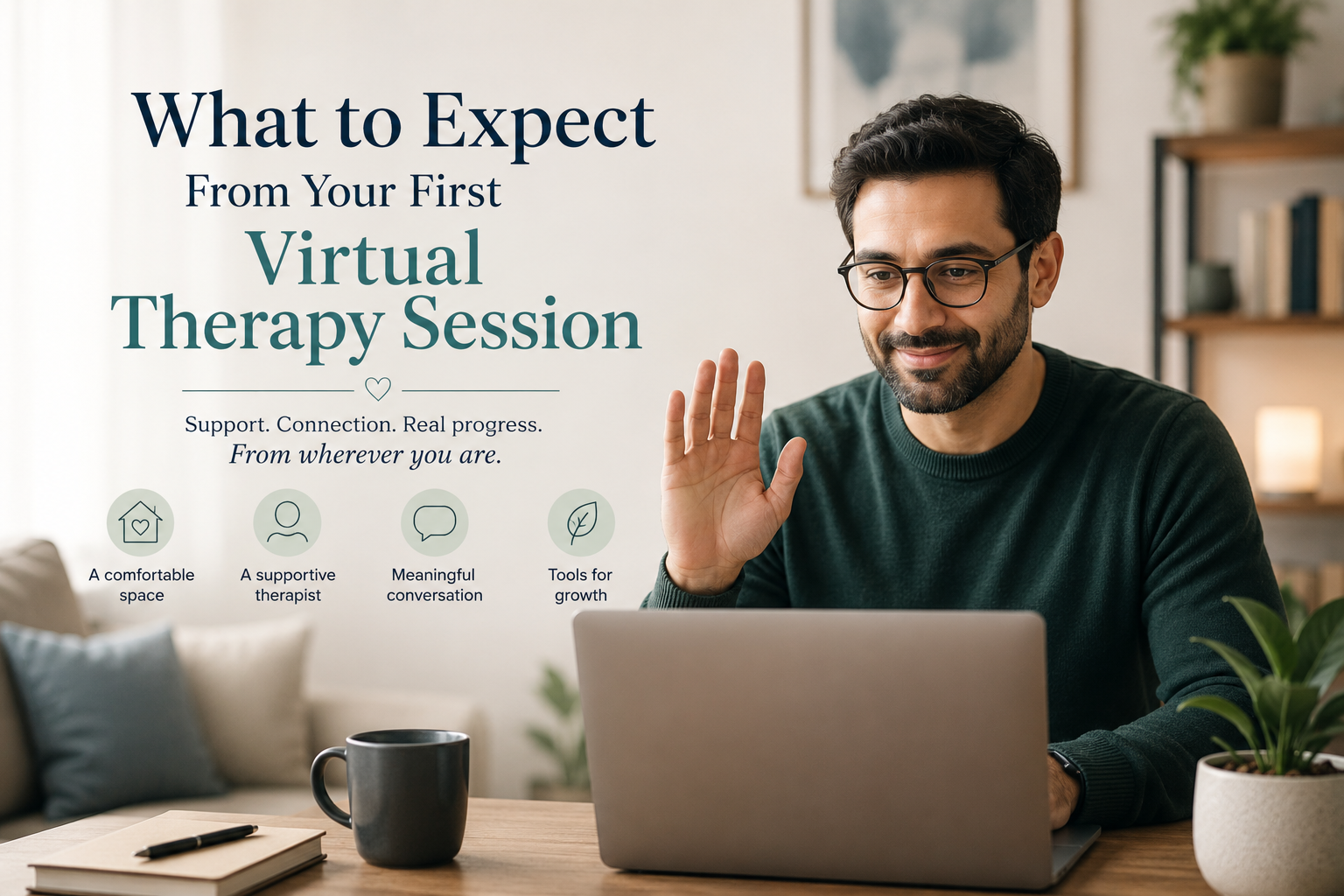
Starting therapy for the first time can feel intimidating.
You may have questions like:
What am I supposed to talk about? What will my therapist ask me? Will I have to talk about everything right away? What if I get emotional?
These questions are completely normal.
Knowing what to expect from your first virtual therapy session can make the process feel a little less overwhelming.
Before Your First Online Therapy Appointment
One of the benefits of virtual therapy is that you don't need to travel to an office.
Before your appointment, find a private and comfortable space where you can speak openly without being interrupted. This might be a bedroom, home office, or another quiet area.
If possible, use headphones and make sure your internet connection and device are working properly.
You don't need a perfectly quiet or perfectly organized home. You simply need a space where you feel reasonably comfortable and able to focus.
What Happens During the First Session?
Your first therapy session is usually about getting to know one another and understanding what brought you to therapy.
Your therapist may ask questions about:
What has been happening recently
What prompted you to seek therapy
How you're feeling emotionally
Your relationships and support system
What you'd like to change
What you're hoping to get from therapy
You don't need to have all the answers.
Sometimes people come to therapy knowing exactly what they want to work on. Other times they simply know that something doesn't feel right.
Both are completely valid reasons to start therapy.
Do I Have to Talk About Everything?
No.
Therapy isn't about telling your therapist everything during your first appointment.
You are allowed to take your time.
Building trust is a process. Your therapist's role is not to force you to talk about things before you're ready, but to create a space where you can gradually explore what is important to you.
You may become emotional. You may not know what to say. You may even laugh at something unexpected.
There is no “perfect” way to do therapy.
What If I Don't Know What I Need?
You don't need to diagnose yourself before starting therapy.
You don't need to know whether you have anxiety, depression, attachment concerns, or another mental health issue.
You simply need to recognize that you could use some support.
A therapist can help you understand what you're experiencing and determine where to begin.
What About Virtual Therapy Specifically?
Virtual therapy can actually feel more comfortable than you might expect.
You are able to participate from a familiar environment, which can help reduce some of the anxiety associated with attending a new appointment.
At the same time, it is important to create some boundaries around your therapy time.
If possible, avoid attending from a place where you are likely to be interrupted. Give yourself a few minutes before and after the appointment rather than immediately rushing into your next responsibility.
That transition time can help you process what came up during the session.
What Happens After the First Session?
Your therapist will typically work with you to identify what you'd like to focus on moving forward.
Depending on your needs, therapy may involve learning new coping strategies, understanding emotional patterns, improving communication, processing difficult experiences, or exploring relationship dynamics.
Therapy is a collaborative process. You and your therapist work together to determine what feels most helpful.
You Don't Have to Be “Ready” for Therapy
Many people wait to start therapy because they think they need to have everything figured out first.
You don't.
If you're considering virtual therapy in Georgetown, Halton Hills, or Ontario, your first session can simply be an opportunity to talk, ask questions, and see whether therapy feels like the right fit.
At Meaningful Connections, we offer virtual and in-person therapy for individuals and couples in a warm, supportive environment.
You don't have to know exactly where to begin. We can start there together.Starting therapy for the first time can feel intimidating.
You may have questions like:
What am I supposed to talk about? What will my therapist ask me? Will I have to talk about everything right away? What if I get emotional?
These questions are completely normal.
Knowing what to expect from your first virtual therapy session can make the process feel a little less overwhelming.
Before Your First Online Therapy Appointment
One of the benefits of virtual therapy is that you don't need to travel to an office.
Before your appointment, find a private and comfortable space where you can speak openly without being interrupted. This might be a bedroom, home office, or another quiet area.
If possible, use headphones and make sure your internet connection and device are working properly.
You don't need a perfectly quiet or perfectly organized home. You simply need a space where you feel reasonably comfortable and able to focus.
What Happens During the First Session?
Your first therapy session is usually about getting to know one another and understanding what brought you to therapy.
Your therapist may ask questions about:
What has been happening recently
What prompted you to seek therapy
How you're feeling emotionally
Your relationships and support system
What you'd like to change
What you're hoping to get from therapy
You don't need to have all the answers.
Sometimes people come to therapy knowing exactly what they want to work on. Other times they simply know that something doesn't feel right.
Both are completely valid reasons to start therapy.
Do I Have to Talk About Everything?
No.
Therapy isn't about telling your therapist everything during your first appointment.
You are allowed to take your time.
Building trust is a process. Your therapist's role is not to force you to talk about things before you're ready, but to create a space where you can gradually explore what is important to you.
You may become emotional. You may not know what to say. You may even laugh at something unexpected.
There is no “perfect” way to do therapy.
What If I Don't Know What I Need?
You don't need to diagnose yourself before starting therapy.
You don't need to know whether you have anxiety, depression, attachment concerns, or another mental health issue.
You simply need to recognize that you could use some support.
A therapist can help you understand what you're experiencing and determine where to begin.
What About Virtual Therapy Specifically?
Virtual therapy can actually feel more comfortable than you might expect.
You are able to participate from a familiar environment, which can help reduce some of the anxiety associated with attending a new appointment.
At the same time, it is important to create some boundaries around your therapy time.
If possible, avoid attending from a place where you are likely to be interrupted. Give yourself a few minutes before and after the appointment rather than immediately rushing into your next responsibility.
That transition time can help you process what came up during the session.
What Happens After the First Session?
Your therapist will typically work with you to identify what you'd like to focus on moving forward.
Depending on your needs, therapy may involve learning new coping strategies, understanding emotional patterns, improving communication, processing difficult experiences, or exploring relationship dynamics.
Therapy is a collaborative process. You and your therapist work together to determine what feels most helpful.
You Don't Have to Be “Ready” for Therapy
Many people wait to start therapy because they think they need to have everything figured out first.
You don't.
If you're considering virtual therapy in Georgetown, Halton Hills, or Ontario, your first session can simply be an opportunity to talk, ask questions, and see whether therapy feels like the right fit.
At Meaningful Connections, we offer virtual and in-person therapy for individuals and couples in a warm, supportive environment.
You don't have to know exactly where to begin. We can start there together.
